
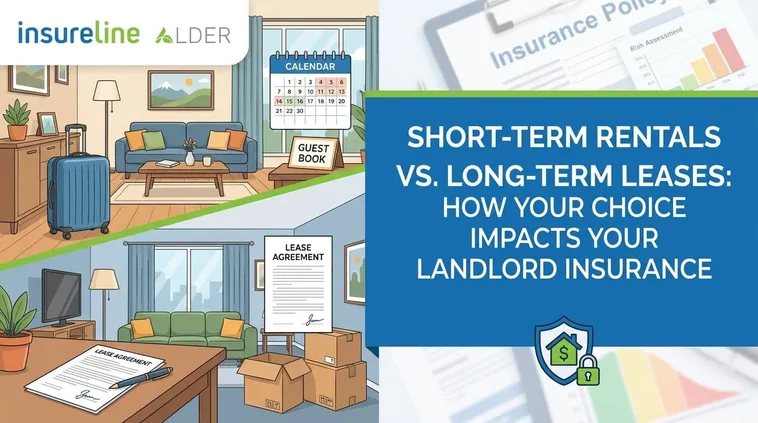
Deciding between hosting transient vacationers and securing permanent tenants fundamentally alters your property’s risk profile. When evaluating Short-Term Rentals vs. Long-Term Leases: How Your Choice Impacts Your Landlord Insurance, many property owners incorrectly assume a standard policy will cover any occupant. In reality, the duration of a guest’s stay dictates how underwriters classify your investment, directly influencing your liability exposure, coverage eligibility, and risk management requirements.
Whether you are managing a single secondary suite or a massive property portfolio, the operational demands of your chosen rental strategy require perfectly aligned protection. Operating with mismatched coverage can lead to denied claims or completely voided policies when you need them most.
Defining Short-Term Rentals vs. Long-Term Leases: How Your Choice Impacts Your Landlord Insurance
Legal Distinctions and Municipal Classifications
Generally, a short-term rental involves stays of fewer than 30 consecutive days, often facilitated through popular online booking platforms. Conversely, long-term leases typically involve tenancy agreements lasting six months to a year or more. Municipalities strictly differentiate between these two models, often classifying short-term stays as commercial hospitality operations rather than standard residential housing.
How Insurers Categorize Your Property
Insurers view these classifications through the lens of risk and intended use. A long-term lease is categorized as a standard tenant-occupied residential property. Short-term rentals, however, are treated as commercial enterprises due to the transient nature of the occupants. At InsureLine Alder, our 25+ years of combined experience have shown us that failing to notify your insurer when switching from a long-term to a short-term model is one of the most common reasons for policy cancellation.
Assessing the Risk Profile: Guest Turnover vs. Tenant Stability
The Liability of High-Frequency Occupancy
High guest turnover introduces a revolving door of unfamiliar individuals into your property. Each new arrival brings a fresh liability risk, from slips and falls to accidental property damage. Vacationers often treat the premises differently than a permanent home, increasing the likelihood of wear and tear, unmonitored appliance usage, and party-related liabilities.
Long-Term Leases and Predictable Maintenance
Long-term tenants provide stability. They have a vested interest in maintaining their living space and promptly reporting maintenance issues like a leaking pipe or a faulty furnace. This predictability significantly lowers the risk of catastrophic damage going unnoticed. When we educate clients first—explaining coverages in layman’s terms—we emphasize that underwriters heavily favor the predictable maintenance schedules and consistent occupancy that long-term leases provide.
Tenant Screening and Its Role in Mitigating Insurance Liabilities
Comprehensive Background Checks for Long-Term Tenants
Securing a long-term tenant involves rigorous vetting, including:
- Comprehensive credit history evaluations
- Detailed employment and income verification
- Direct references from previous landlords
This comprehensive screening acts as a primary risk mitigation tool, ensuring the individual occupying your investment is responsible and financially stable. Insurers recognize this thorough vetting process as a strong indicator of reduced risk.
The Limitations of Booking Platform Vetting
In contrast, short-term booking platforms offer limited vetting, often relying solely on peer reviews and basic identity verification. This automated screening process cannot replace a comprehensive background check. As a result, the risk of property damage or liability claims increases. Our Managing Directors, Gurtaj Bahad and Michael Puni, bring deep industry roots and hands-on problem-solving experience to help property owners navigate these exact screening vulnerabilities and secure the right specialized coverage.

Why Standard Landlord Policies Fall Short for Short-Term Rentals
Common Exclusions for Transient Guests
A standard landlord insurance policy is designed exclusively for properties occupied by long-term, vetted tenants. If a property owner relies on this standard policy while operating a short-term rental, they are operating with a false sense of security. Most standard policies contain explicit exclusions for business pursuits or transient accommodations, meaning any damage caused by a weekend guest will likely be denied.
The Need for Specialized Commercial or Rider Policies
To properly protect a short-term rental, owners must obtain a specialized short-term rental rider or a commercial hospitality policy. These specialized products are designed to cover the unique risks of frequent turnover, including loss of business income if the property becomes uninhabitable. As a brokerage with access to nationwide insurance providers like Aviva, Intact Insurance, and Wawanesa Insurance, we advocate for our clients with underwriters to ensure these specific commercial coverages are properly structured.
Property Damage and Liability: How Claims Differ by Rental Type
Handling Vacationer Wear and Tear vs. Tenant Damage
When evaluating Short-Term Rentals vs. Long-Term Leases: How Your Choice Impacts Your Landlord Insurance, the claims process reveals stark differences. Damage caused by long-term tenants is often addressed through security deposits and standard landlord property coverage for sudden, accidental events. However, short-term rentals experience rapid wear and tear that insurers classify as maintenance rather than insurable damage.
Liability Exposure and Coverage Limits
Liability exposure is exponentially higher with short-term guests. If a vacationer is injured on your property, the resulting liability claim can be devastating. Specialized short-term rental policies provide enhanced liability limits to address this commercial-level exposure. Our team at InsureLine Alder provides a 24-hour response guarantee, ensuring that if a liability incident occurs, we are there immediately to assist our clients during the claims process.

The Impact of Vacancy Clauses on Your Rental Property Coverage
Off-Season Unoccupancy Risks in Short-Term Rentals
Short-term rentals are highly susceptible to seasonal fluctuations, often sitting empty for weeks during the off-season. Most insurance policies contain a strict vacancy clause, which can void coverage for risks like water damage or vandalism if the property is unoccupied for more than 30 to 60 consecutive days.
Maintaining Coverage During Tenant Transitions
Long-term leases generally avoid this issue, as transitions between tenants usually take only a few days. However, if you are renovating between long-term leases or experiencing a prolonged vacancy in your short-term rental, you must secure a vacancy permit. With our impressive 95% client retention rate, we proactively mandate reviews at renewal and maintain continuous updates on your insurance status, ensuring coverage gaps like unmonitored vacancies are identified early.
Navigating Short-Term Rental Bylaws for Insurance Compliance
The Link Between Municipal Licensing and Valid Coverage
Insurance contracts require the policyholder to operate within the bounds of the law. Many municipalities have introduced strict bylaws requiring short-term rental operators to obtain specific business licenses and adhere to zoning restrictions.
Avoiding Policy Voidance Due to Regulatory Non-Compliance
If you operate a short-term rental without the required municipal licenses, your insurance policy can be rendered completely invalid. In the event of a fire or major liability claim, the insurer will investigate your regulatory compliance. Operating illegally gives the insurer grounds to deny the claim. We ensure our clients understand these complex requirements, acting as a one-stop insurance shop to align your business practices with your coverage terms.

Conclusion: Short-Term Rentals vs. Long-Term Leases: How Your Choice Impacts Your Landlord Insurance
Aligning Your Rental Goals with the Proper Coverage
The debate of short-term versus long-term renting ultimately comes down to your operational capacity and risk tolerance. Short-term rentals demand active management and robust commercial-grade policies, while long-term leases offer stability backed by standard landlord protection.
Consult with an Insurance Professional
Protecting your real estate investment requires tailored solutions that fit your specific needs. At InsureLine Alder, our Managing Directors, Gurtaj Bahad (CIP, CAIB) and Michael Puni (Level 2 Insurance Broker), are dedicated to providing peace of mind through personalized risk management. We are open 7 days a week and commit to reviewing your policy every year to ensure your coverages evolve alongside your rental strategy. Reach out to our team today to secure the precise protection your property demands.